
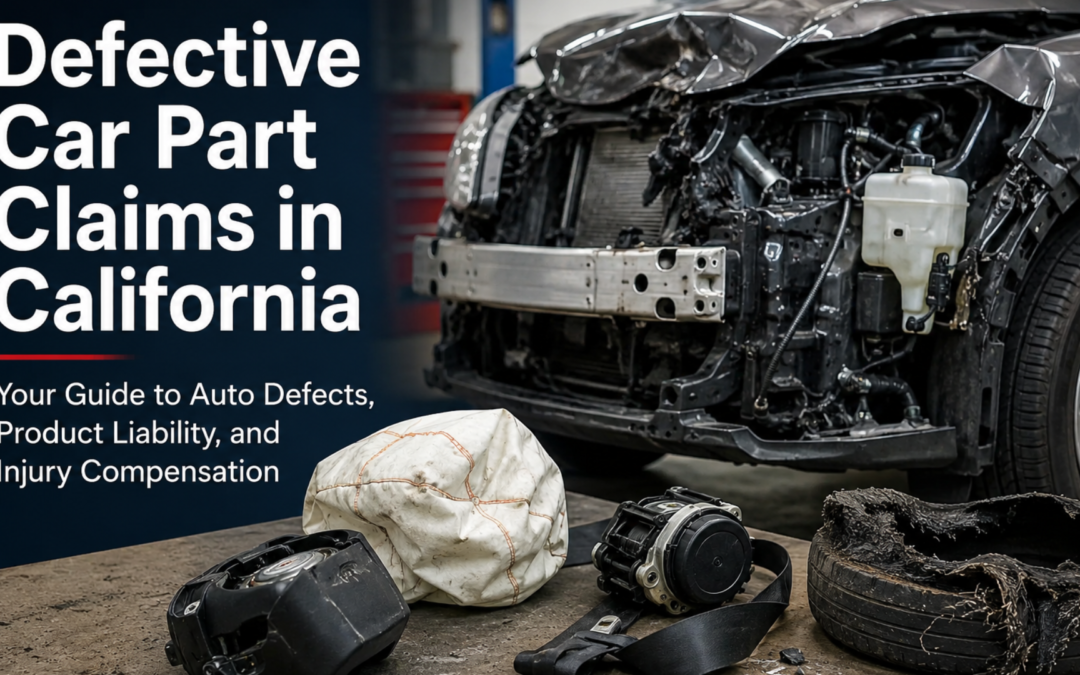
When a serious car accident occurs, attention usually turns first to the drivers involved. Was someone speeding? Did a driver run a red light? Was distracted driving responsible for the collision?
But sometimes the vehicle itself—or one of its components—causes the accident or makes the resulting injuries significantly worse.
Defective brakes may prevent a driver from stopping. A tire can suddenly fail at highway speed. An airbag may fail to deploy during a collision. A defective seat belt may fail to restrain an occupant. Steering or suspension components can malfunction and cause a driver to lose control.
When a defective car part causes an accident or contributes to serious injuries, the manufacturer or another party in the product’s distribution chain may potentially be held responsible under California product liability law.
Importantly, an auto defect does not necessarily have to cause the initial collision to become relevant to an injury claim.
A defective safety system may instead make an otherwise survivable accident substantially more dangerous. For example, a collision may be caused by another driver’s negligence, while a defective airbag or seat belt contributes to the severity of an occupant’s injuries.
Potential vehicle defects may involve:
- Airbags
- Seat belts and restraint systems
- Tires
- Braking systems
- Steering components
- Vehicle roofs
- Fuel systems
- Seats and seatbacks
- Electronic safety systems
- Suspension components
- Other vehicle parts or safety equipment
Cases involving auto defects can be substantially different from ordinary car accident claims. They may require preservation and inspection of the vehicle, analysis of engineering and manufacturing evidence, investigation of recalls and similar incidents, and testimony from qualified experts.
The vehicle itself can become one of the most important pieces of evidence in the entire case.
For that reason, repairing, selling, disposing of, or allowing a severely damaged vehicle to be destroyed before a potential defect has been investigated could result in the loss of critical evidence.
This guide explains when a defective vehicle or component may lead to a California product liability claim, common automotive defects, who may potentially be responsible, what evidence should be preserved, and the compensation that may be available when a defective product causes or worsens serious injuries.
When Can a Defective Car Part Create a Legal Claim?
A defective car part may create a legal claim when a defect in the vehicle or one of its components causes an accident or contributes to the injuries suffered in a collision.
California product liability law can potentially apply to defects involving the design, manufacture, or warnings associated with a product. The precise legal theories available depend on the circumstances and the type of defect involved.
The Defect Can Cause the Accident
Some defects directly contribute to a driver losing control of the vehicle or being unable to avoid a collision.
Examples may include:
- Brake failure
- Steering failure
- Tire separation or blowouts
- Suspension failures
- Accelerator defects
- Electrical system failures
- Defective autonomous or driver-assistance systems
For example, if a defective steering component suddenly fails while a vehicle is traveling at highway speed, the resulting loss of control could cause a serious collision even though the driver did nothing wrong.
A Defect Can Also Make Injuries Worse
A vehicle defect does not always cause the crash itself.
Automobiles contain numerous safety systems designed to protect occupants when collisions occur. If one of those systems fails, the defect may contribute to injuries that otherwise could have been prevented or reduced.
Examples include:
- An airbag that fails to deploy
- A seat belt that unlatches during impact
- A seatback that collapses
- A roof that cannot adequately protect occupants during a rollover
- A fuel system that contributes to a post-collision fire
These cases are sometimes referred to as crashworthiness or enhanced-injury cases because the issue is not necessarily what caused the original collision, but whether a vehicle defect caused additional or more severe injuries.
More Than One Party Can Be Responsible
A product defect claim and a negligence claim against another driver are not necessarily mutually exclusive.
For example, another driver might cause a collision by running a red light while a defective restraint system contributes to the severity of an occupant’s injuries.
Depending on the evidence, responsibility for the resulting harm may involve more than one party.
This makes careful investigation especially important in accidents involving unusually severe injuries, unexpected failures of safety equipment, or circumstances suggesting the vehicle did not perform as intended.
Serious Injuries Can Be an Important Warning Sign
Not every severe injury indicates that a vehicle was defective. However, certain circumstances may justify a closer investigation.
Questions may arise when:
- An airbag unexpectedly fails to deploy.
- A seat belt releases during a collision.
- A vehicle roof collapses significantly during a rollover.
- A tire fails without an obvious road hazard.
- A seat or seatback fails during impact.
- A vehicle catches fire following a collision.
- A critical component fails shortly before the crash.
Determining whether a defect actually contributed to the accident or injuries generally requires examination of the physical evidence and, in many cases, analysis by qualified automotive or engineering experts.
Understanding the different ways a vehicle can fail is the next step. Some defects involve individual components, while others involve systems specifically designed to protect occupants from catastrophic injury.
Common Vehicle Defects That Cause or Worsen Injuries
Modern vehicles contain thousands of components, and a failure in even one critical system can potentially cause an accident or make the resulting injuries more severe.
Some defects affect the driver’s ability to control or stop the vehicle. Others involve safety systems designed to protect occupants when a collision occurs.
Defective Airbags
Airbags are designed to reduce the risk of serious injury during certain types of collisions. When an airbag system is defective, it may fail to provide the protection an occupant reasonably expects.
Potential airbag problems can include:
- Failure to deploy
- Deployment at the wrong time
- Excessively forceful deployment
- Defective sensors
- Improper inflation
- Rupturing inflators
- Deployment of an airbag when no collision has occurred
An airbag defect may contribute to traumatic brain injuries, facial injuries, eye injuries, burns, fractures, or other serious harm.
Defective Seat Belts and Restraint Systems
Seat belts are another critical occupant-protection system.
A defective seat belt may:
- Unlatch during impact
- Fail to retract properly
- Fail to lock during a collision
- Tear or separate
- Fail because of a defective buckle or anchor
- Improperly restrain an occupant
When a restraint system fails during a severe collision, the occupant may strike the vehicle interior or be partially or completely ejected.
Tire Defects
A sudden tire failure can cause a driver to lose control, particularly at highway speeds.
Potential defects may include:
- Tread separation
- Belt separation
- Sidewall failure
- Manufacturing defects
- Structural failures
Tire-related cases require careful investigation because tire failure can also result from road hazards, improper inflation, excessive wear, overloading, or inadequate maintenance.
Preserving the failed tire and vehicle can be critical to determining why the failure occurred.
Brake System Defects
Drivers depend on their brakes to respond predictably, particularly during emergencies.
Potential brake defects can involve:
- Brake components
- Hydraulic systems
- Electronic braking controls
- Anti-lock braking systems
- Sensors
- Software
A sudden brake-system failure may leave a driver unable to slow or stop the vehicle in time to avoid a collision.
Steering and Suspension Defects
A failure involving the steering or suspension system can cause an unexpected loss of vehicle control.
Potential problems may involve:
- Steering columns
- Tie rods
- Ball joints
- Power-steering systems
- Suspension components
- Electronic steering controls
Failures occurring at freeway speeds can result in rollovers, roadway departures, or collisions with other vehicles.
Defective Seats and Seatbacks
Seats are designed not only for comfort but also to help protect occupants during collisions.
If a seat or seatback collapses during impact, an occupant may be thrown backward or displaced from the position in which the seat belt and airbags were designed to provide protection.
These failures can contribute to serious head, neck, and spinal injuries.
Roof-Crush and Rollover Defects
During a rollover accident, the vehicle’s roof structure plays an important role in maintaining occupant survival space.
A roof that significantly collapses during a rollover may contribute to:
- Head injuries
- Neck injuries
- Spinal cord injuries
- Paralysis
- Fatal injuries
Rollover cases may require analysis of the vehicle’s structural design as well as the circumstances that caused the vehicle to overturn.
Fuel System Defects and Vehicle Fires
A collision that would otherwise be survivable can become catastrophic if a defective fuel or electrical system contributes to a fire.
Potential issues may involve:
- Fuel tanks
- Fuel lines
- Batteries
- Electrical systems
- Defective components that create ignition sources
Vehicle fires can cause severe burns, respiratory injuries, disfigurement, and death.
Driver-Assistance and Electronic System Defects
Modern vehicles increasingly rely on software, sensors, cameras, and electronic systems.
Potential failures may involve technologies such as:
- Automatic emergency braking
- Lane-keeping systems
- Adaptive cruise control
- Collision-warning systems
- Electronic stability control
- Other advanced driver-assistance features
Determining whether an electronic system contributed to a collision may require analysis of vehicle data, software behavior, sensor information, and other technical evidence.
A Recall Is Not Required for a Vehicle to Be Defective
Consumers sometimes assume that an auto defect claim is only possible when the vehicle or component has already been recalled.
That is not necessarily the case.
A defect may exist before a manufacturer or government agency announces a recall, and some potentially defective products may never become the subject of a formal recall.
Recall information can be important evidence, but determining whether a vehicle was defective requires evaluating the specific vehicle, component, accident, and available evidence.
The nature of the defect also matters legally. A vehicle component can potentially be defective because of a problem with its fundamental design or because something went wrong when the particular component was manufactured.
Design Defects vs. Manufacturing Defects
Not all defective vehicle claims involve the same type of problem. In some cases, the problem exists in the underlying design of the vehicle or component. In others, the design may be appropriate, but something goes wrong during the manufacturing process.
Understanding the distinction between a design defect and a manufacturing defect can be important when determining how an automotive product failed and who may be responsible.
What Is a Design Defect?
A design defect involves a problem with the way a product was designed.
Because the problem originates in the design itself, multiple vehicles or components manufactured according to that design may potentially contain the same dangerous characteristic.
Automotive examples might involve allegations concerning:
- A vehicle roof that provides inadequate protection during rollovers
- A fuel system vulnerable to rupture during foreseeable collisions
- A seatback that does not provide adequate strength during impact
- A vehicle design that creates an unreasonable rollover risk
- A safety system that fails to adequately protect occupants
- Placement or design of components that creates an unreasonable risk of injury
Determining whether a vehicle contains a legally actionable design defect can require extensive engineering analysis and application of California product liability law to the specific facts.
What Is a Manufacturing Defect?
A manufacturing defect generally occurs when a particular product differs from its intended design because of something that happened during production or assembly.
The underlying design may be appropriate, but an individual vehicle or component may be defective because it was not manufactured as intended.
Examples could include:
- Improperly assembled components
- Defective materials
- Incorrectly installed fasteners
- Contamination during manufacturing
- Improper welding
- Components produced outside required specifications
For example, a properly designed steering component could still fail if the particular component installed in a vehicle was manufactured with defective material.
Why the Difference Matters
Identifying whether a failure resulted from design or manufacturing can influence the type of evidence needed to investigate the case.
A suspected design defect may require examination of:
- Engineering specifications
- Design documents
- Testing data
- Alternative designs
- Similar incidents
- Industry and safety information
A manufacturing-defect investigation may focus more heavily on:
- The failed component itself
- Manufacturing specifications
- Quality-control records
- Materials
- Assembly processes
- Differences between the failed component and properly manufactured examples
In either situation, preserving the vehicle and failed components can be extremely important.
The Same Accident Can Raise Multiple Product Questions
An investigation does not always reveal a single, obvious defect theory at the beginning.
For example, an airbag that fails to deploy could potentially involve questions concerning:
- The design of the airbag system
- A defective sensor
- Manufacturing of an individual component
- Software or electronic controls
- Installation
- Maintenance or prior repairs
Technical investigation may be necessary before determining exactly why the system failed.
Evidence Can Reveal a Broader Pattern
Information about other vehicles or similar component failures may also become relevant.
Depending on the case, investigators may examine:
- Manufacturer recalls
- Technical service bulletins
- Consumer complaints
- Prior incidents
- Testing results
- Government investigations
- Internal manufacturer records obtained during litigation
Evidence of similar failures does not automatically establish that a particular vehicle was defective, but it may become important when evaluating the product and the manufacturer’s knowledge of a potential safety problem.
Defects Are Not Limited to Physical Design and Manufacturing
Even when a product is properly designed and manufactured, another product liability issue can arise if foreseeable risks are not accompanied by adequate warnings or instructions.
This can be particularly relevant when a vehicle component requires specific installation, maintenance, operation, or replacement procedures to be used safely.
Failure to Warn and Inadequate Safety Instructions
A vehicle or automotive component may also raise product liability concerns when foreseeable risks are not accompanied by adequate warnings or instructions.
This type of claim is often referred to as a failure-to-warn claim.
Unlike a design or manufacturing defect, the product itself may function as intended. The issue is whether users were adequately informed about risks associated with its foreseeable use.
What Is a Failure to Warn?
Manufacturers may have a duty to provide appropriate warnings about certain known or reasonably knowable risks associated with their products.
Depending on the circumstances, an automotive failure-to-warn claim might involve inadequate information concerning:
- Safe operation
- Installation requirements
- Maintenance procedures
- Replacement intervals
- Load or weight limitations
- Known safety risks
- Compatibility with other components
- Conditions under which a component should no longer be used
Whether a warning was legally required or adequate depends on the specific product, risk, and circumstances.
Instructions Can Be as Important as Warnings
Some automotive components require proper installation or maintenance to function safely.
Instructions may be particularly important for products such as:
- Replacement tires
- Aftermarket vehicle components
- Child restraint systems
- Towing equipment
- Replacement safety components
- Performance modifications
- Vehicle accessories
Incomplete or unclear instructions may create risks when a product is installed or used in a reasonably foreseeable manner.
Warning Labels Alone May Not Resolve the Issue
The existence of a warning does not necessarily answer whether adequate information was provided.
Questions may include:
- Was the warning sufficiently clear?
- Was it located where a user would reasonably see it?
- Did it adequately describe the risk?
- Did the manufacturer provide appropriate instructions for avoiding the danger?
- Was the risk already known or reasonably knowable when the product was distributed?
These issues can require examination of manuals, labels, technical documents, marketing materials, and other information supplied with the vehicle or component.
Failure-to-Warn Cases May Involve Post-Sale Information
Safety information can also emerge after a vehicle or component has entered the marketplace.
Manufacturers may issue:
- Safety recalls
- Owner notifications
- Technical service bulletins
- Updated instructions
- Repair campaigns
- Other safety communications
When a serious accident occurs, determining what the manufacturer knew about a potential problem—and when it knew it—may become an important part of the investigation.
Preserve Manuals, Notices, and Repair Records
When a suspected auto defect is involved, physical vehicle evidence is critical, but documents associated with the vehicle can also be valuable.
Preserve items such as:
- Owner’s manuals
- Recall notices
- Repair invoices
- Maintenance records
- Dealership communications
- Warranty documents
- Parts receipts
- Emails or letters concerning vehicle problems
These records may help establish the vehicle’s history and whether warnings, repairs, or prior problems were involved.
Product Liability May Extend Beyond the Manufacturer
Determining that a vehicle or component was defective is only part of the analysis. The next question is identifying which businesses or other parties may potentially bear legal responsibility.
Depending on how the vehicle or component was designed, manufactured, distributed, sold, installed, or repaired, the investigation may extend beyond the company whose name appears on the vehicle.
Who Can Be Held Responsible for a Defective Vehicle?
When a defective vehicle or automotive component causes an accident or contributes to serious injuries, responsibility may extend beyond the vehicle manufacturer.
Depending on the circumstances, multiple companies or other parties may have been involved in designing, manufacturing, distributing, selling, installing, or servicing the defective product.
Identifying every potentially responsible party can be especially important in cases involving catastrophic injuries or wrongful death.
Vehicle Manufacturers
The manufacturer of the vehicle may be a central focus of an auto defect investigation.
Potential claims may involve problems with:
- Vehicle design
- Structural integrity
- Safety systems
- Electronic systems
- Component integration
- Manufacturing or assembly
Even when a failed component was produced by another company, questions may arise about how the automaker selected, tested, incorporated, or monitored that component.
Component and Parts Manufacturers
Automakers rely on numerous suppliers to manufacture individual vehicle components.
A separate manufacturer may have produced the:
- Airbag or inflator
- Seat belt assembly
- Tire
- Brake component
- Steering component
- Electronic sensor
- Battery
- Seat or seatback
- Other failed part
If the defect originated with a particular component, the company responsible for designing or manufacturing that part may potentially become a defendant in a product liability case.
Distributors and Sellers
Depending on the facts and applicable California law, businesses involved in the distribution and sale of a defective product may also potentially face liability.
This can include entities within the commercial chain through which a defective vehicle or component reached the consumer.
Determining which companies participated in that chain may require reviewing purchase records, invoices, product documentation, and corporate information.
Dealerships, Repair Shops, and Installers
Not every vehicle failure originates with the original manufacturer.
Sometimes a properly designed and manufactured component becomes dangerous because it was incorrectly installed, repaired, or serviced.
Potential examples include:
- Improperly installed replacement parts
- Incorrect brake repairs
- Improper tire installation
- Failure to properly secure critical components
- Negligent maintenance or repair work
- Incorrect installation of aftermarket equipment
In these situations, a repair facility, dealership, installer, or another service provider may potentially share responsibility.
Aftermarket Parts Manufacturers
Vehicle owners frequently install replacement or aftermarket components that were not manufactured by the original automaker.
These may include:
- Wheels and tires
- Suspension components
- Performance parts
- Replacement lighting
- Towing equipment
- Electronic equipment
- Other vehicle modifications
If an aftermarket component is defective and contributes to an accident or injury, the manufacturer or another business associated with that product may potentially be involved in the claim.
Multiple Companies May Share Responsibility
Complex auto defect cases sometimes involve several defendants.
For example, an investigation might determine that one company designed a component, another manufactured it, another supplied it to the automaker, and the automaker installed it in the vehicle.
The facts may also show that negligent conduct by another driver contributed to the original collision.
This is why a serious auto accident should not always be viewed solely as a claim against the driver who appears to have caused the crash.
In some cases, the evidence may point to multiple contributing causes and multiple potentially responsible parties.
What If Another Driver Also Caused the Accident?
A defective vehicle claim does not necessarily disappear simply because another driver caused or contributed to the collision.
Some serious accidents involve multiple causes. One party’s negligence may cause the initial crash, while a defective vehicle or safety component contributes to the severity of the injuries.
An Accident Can Have More Than One Cause
Consider a collision in which another driver runs a red light and strikes a vehicle from the side.
The other driver may be responsible for causing the crash. But if the struck vehicle’s seat belt unexpectedly unlatches or an airbag fails to deploy, a product defect may have contributed to injuries that were more severe than they otherwise would have been.
Depending on the evidence, the resulting case could involve claims against both the negligent driver and one or more parties associated with the defective vehicle or component.
California Uses Comparative Fault
California follows a pure comparative negligence system. In general, this means responsibility for an injury can be allocated among parties according to their respective share of fault.
This can become particularly important in complex accidents involving:
- Negligent drivers
- Defective vehicles or components
- Dangerous roadway conditions
- Negligent vehicle maintenance or repair
- Multiple vehicles or other responsible parties
Determining how the accident occurred and what caused each injury may therefore require a much broader investigation than simply reviewing the police report.
The Defect May Have Caused Only Part of the Harm
In some cases, experts may need to distinguish between injuries caused by the initial collision and additional injuries allegedly caused or worsened by a defective product.
For example, investigators may examine whether an occupant would have suffered substantially less severe injuries if:
- An airbag had deployed properly
- A seat belt had remained latched
- A seatback had maintained its position
- The roof had better preserved occupant survival space
- A fuel system had not contributed to a post-collision fire
This analysis can involve accident reconstruction, biomechanics, engineering, medical evidence, and other specialized fields.
Do Not Assume the Police Report Identifies Every Responsible Party
Police investigations generally focus on how a traffic collision occurred. They may identify speeding, unsafe turns, distracted driving, impairment, or other traffic violations.
However, a police report may not determine whether an airbag, seat belt, tire, structural component, or electronic safety system was defective.
Evidence of a product defect may only become apparent after the vehicle is examined by qualified experts.
A Thorough Investigation Can Identify Additional Sources of Recovery
Identifying all potentially responsible parties can be particularly important when an accident causes catastrophic injuries, permanent disability, or death.
The damages in these cases can be substantial, and the insurance available through a negligent driver alone may not be sufficient to compensate for the losses involved.
A complete investigation may therefore examine not only who caused the collision, but also whether a defective product, dangerous roadway, negligent repair, or another factor contributed to the resulting harm.
Certain vehicle safety systems deserve especially close attention because their primary purpose is to protect occupants when a crash occurs.
How Defective Airbags, Seat Belts, and Tires Affect Injury Claims
Airbags, seat belts, and tires are among the most important safety components in a vehicle. When one of these systems fails, the consequences can be severe.
Each type of failure also presents different questions when investigating whether a product defect contributed to an accident or injury.
Defective Airbags
Airbags are designed to work together with seat belts and other vehicle safety systems to reduce the risk of serious injury during certain collisions.
Potential airbag defects may involve:
- Failure to deploy during a qualifying collision
- Delayed deployment
- Unintended deployment
- Excessively forceful deployment
- Defective inflators
- Faulty crash sensors
- Electronic or software failures
When an airbag does not perform as expected, investigators may examine the severity and direction of the impact, sensor data, electronic records, the airbag control module, and the physical condition of the system.
An airbag that fails to deploy does not automatically establish that the system was defective. Airbags are designed to deploy only under certain circumstances, which is why technical analysis may be necessary.
Defective Seat Belts
Seat belts help keep occupants properly positioned during a collision so that other safety systems can provide protection.
Potential seat belt failures may include:
- Buckles that unexpectedly unlatch
- Retractors that fail to lock
- Torn or separated webbing
- Defective anchors
- Improper restraint during impact
- Components that fail under collision forces
A failed restraint system can contribute to an occupant striking the dashboard, windshield, roof, doors, or other parts of the vehicle. In severe crashes, it may also contribute to occupant ejection.
These failures can result in traumatic brain injuries, spinal cord injuries, fractures, internal injuries, and other life-changing harm.
Defective Tires
Tires are the vehicle’s direct connection to the roadway, making their structural integrity critical to maintaining control.
One particularly serious type of tire failure is tread separation, in which the tread separates from other portions of the tire.
A sudden failure can cause a vehicle to:
- Veer unexpectedly
- Leave the roadway
- Spin
- Strike another vehicle
- Roll over
Investigating a tire failure may involve examining the tire’s age, manufacturing information, maintenance history, inflation, tread condition, loading, physical damage, and the circumstances of the accident.
Preserve the Failed Components
After a serious collision, damaged airbags, seat belts, tires, and other vehicle components may appear to be debris. In a potential auto defect case, however, they may be critical evidence.
A failed tire should not simply be discarded.
A damaged seat belt should not be replaced before it can be inspected.
The vehicle’s electronic systems should not be altered unnecessarily.
And the vehicle itself should generally be preserved when there is reason to suspect a defect contributed to serious injuries.
Once physical evidence has been destroyed or substantially altered, determining exactly why a component failed may become far more difficult.
That makes evidence preservation one of the most important early considerations in a suspected auto defect case.
Evidence That Should Be Preserved After a Suspected Auto Defect
Evidence preservation can be especially important in an auto defect case because the vehicle and its components may provide the physical proof needed to determine what went wrong.
After a serious collision, an insurance company may declare the vehicle a total loss and arrange for it to be moved, sold at auction, salvaged, or destroyed. Repairs can also alter or eliminate evidence of how a component performed during the crash.
When a potential vehicle defect is suspected, steps may need to be taken quickly to preserve the vehicle in its post-accident condition.
Preserve the Vehicle
The damaged vehicle may be one of the most important pieces of evidence in the case.
Depending on the suspected defect, experts may need to inspect:
- Airbags and airbag modules
- Seat belts and buckles
- Seats and seatbacks
- Tires and wheels
- Brake components
- Steering and suspension systems
- Roof and structural components
- Fuel and electrical systems
- Sensors and electronic safety equipment
Whenever possible, the vehicle should not be repaired, dismantled, sold, or destroyed before appropriate inspections can occur.
Preserve Failed or Detached Parts
Components separated from the vehicle during or after the collision should also be preserved.
Examples can include:
- Failed tires or pieces of tread
- Broken suspension components
- Seat belt parts
- Airbag components
- Broken fasteners
- Electronic modules
- Other damaged vehicle parts
Even a component that appears insignificant may help an expert determine how and why a failure occurred.
Vehicle Electronic Data May Be Important
Modern vehicles can contain electronic information that helps reconstruct what happened before and during a collision.
Depending on the vehicle, potentially relevant information may include data concerning:
- Vehicle speed
- Braking
- Accelerator input
- Seat belt status
- Airbag deployment
- Engine information
- Stability-control systems
- Other vehicle events
The information available varies significantly by vehicle and system, and specialized equipment or expertise may be required to retrieve it.
Photograph and Document the Vehicle
Detailed photographs and video can help document the condition of the vehicle before it is moved, repaired, or altered.
Useful documentation may include:
- Exterior damage
- Vehicle interior
- Airbag condition
- Seat belt positions
- Tires and wheels
- Seats and head restraints
- Roof deformation
- Fire damage
- Failed components
- Overall accident scene
Photographs taken immediately after the collision can also provide context that may no longer be available later.
Keep Maintenance and Repair Records
A vehicle’s history can become important when determining whether a component failed because of a defect, improper repair, inadequate maintenance, or another cause.
Preserve records involving:
- Routine maintenance
- Tire purchases and rotations
- Brake repairs
- Previous collision repairs
- Dealership service
- Warranty work
- Recall repairs
- Aftermarket modifications
Receipts and service records can also help identify exactly which replacement parts were installed and who performed the work.
Save Recall and Manufacturer Communications
Keep any correspondence concerning the vehicle, including recall notices, warranty letters, dealership communications, technical notices, and manufacturer emails.
Even communications received after the accident may become relevant to the investigation.
Do Not Rely Solely on Photographs
Photographs are valuable, but they cannot always substitute for the physical vehicle.
An engineer may need to measure components, examine fracture surfaces, inspect internal mechanisms, retrieve electronic information, or perform other testing that cannot be accomplished from photographs alone.
For this reason, preserving the actual vehicle and potentially defective components can be critical.
Once the evidence has been properly preserved and the responsible parties identified, the next question is the extent of the losses caused by the defective product.
What Compensation May Be Available?
When a defective vehicle or automotive component causes an accident or makes an occupant’s injuries more severe, the injured person may be able to pursue compensation for the losses resulting from those injuries.
The value of a product liability claim depends on the specific circumstances, including the severity of the injuries, the long-term effects on the person’s life, the available evidence, and the parties responsible for the harm.
Medical Expenses
Compensation may include medical expenses associated with treating accident-related injuries, such as:
- Emergency medical care
- Hospitalization
- Surgery
- Diagnostic testing
- Specialist treatment
- Physical and occupational therapy
- Prescription medications
- Medical equipment
- Follow-up care
For severe injuries, medical treatment may continue for months or years after the accident.
Future Medical Care and Rehabilitation
Catastrophic injuries may require extensive future treatment.
Potential future costs can include:
- Additional surgeries
- Rehabilitation
- In-home medical care
- Assistive devices
- Prosthetics
- Mobility equipment
- Home or vehicle modifications
- Long-term medication
- Ongoing therapy
- Future diagnostic care
In cases involving permanent injuries, medical and financial experts may be needed to evaluate the anticipated cost of care over the injured person’s lifetime.
Lost Income
If an injury prevents someone from working during recovery, compensation may potentially include income lost because of the accident.
Documentation may include employment records, wage statements, tax records, and information from employers.
Loss of Future Earning Capacity
Some injuries permanently affect a person’s ability to perform their previous occupation or earn the income they could reasonably have expected without the injury.
This is different from simply calculating wages missed during recovery.
Evaluating lost earning capacity may require considering the person’s:
- Age
- Occupation
- Education
- Work history
- Skills
- Career trajectory
- Physical limitations
- Future employment opportunities
Vocational and economic experts may be used in cases involving substantial future losses.
Pain and Suffering
Compensation may also be available for the physical and emotional effects of an injury.
Depending on the circumstances, these damages may involve:
- Physical pain
- Emotional distress
- Disability
- Disfigurement
- Loss of enjoyment of life
- Reduced independence
- Other effects on daily living
There is no single formula that determines the value of these losses. The nature, severity, duration, and long-term consequences of the injuries are important considerations.
Property Damage and Other Economic Losses
A claim may also involve other financial losses resulting from the accident, including damage to personal property and certain accident-related expenses.
The recoverability of a particular loss depends on the facts and applicable law.
Wrongful Death Damages
When a defective vehicle or component contributes to a fatal accident, surviving family members may potentially have a wrongful death claim.
These cases can involve different categories of damages and legal requirements than a personal injury claim.
Severe Injuries Require a Long-Term View
One of the risks in a serious injury case is evaluating damages before the full consequences of the injury are understood.
A settlement generally resolves the claim permanently. If future medical complications, disability, or loss of earning capacity were underestimated, an injured person typically cannot reopen the resolved claim simply because the long-term costs turned out to be greater than expected.
For catastrophic injuries, accurately evaluating future needs can therefore be just as important as calculating losses that have already occurred.
California law also places deadlines on product liability and personal injury claims, making it important to investigate a suspected vehicle defect without unnecessary delay.
How Long Do You Have to File a Product Liability Claim in California?
California law imposes deadlines for filing lawsuits involving personal injuries and defective products. Missing an applicable deadline can prevent an injured person from pursuing compensation, regardless of how strong the underlying claim might otherwise be.
For many California personal injury and product liability cases involving injury, the general statute of limitations is two years from the date of the injury.
However, determining the actual deadline in an auto defect case is not always as simple as counting two years from the accident.
Different Circumstances Can Affect the Deadline
The time available to bring a claim can depend on factors such as:
- When the injury occurred
- When the injury or its cause was discovered
- The age or legal status of the injured person
- The identity of the defendants
- Whether a government entity is involved
- Other circumstances that may affect or alter the applicable deadline
Because exceptions and different procedural requirements can apply, an injured person should not assume that the general two-year period necessarily determines the deadline in a particular case.
Evidence Can Disappear Long Before the Legal Deadline
The statute of limitations is not the only reason to investigate an auto defect claim promptly.
Physical evidence may disappear within days or weeks of an accident.
A totaled vehicle may be:
- Transferred to a salvage yard
- Sold at auction
- Dismantled for parts
- Repaired
- Crushed or destroyed
Electronic vehicle data may also be lost or overwritten, and witnesses’ memories can become less reliable with time.
As a result, waiting until the statute of limitations is approaching can create serious evidence problems even if the lawsuit itself can still technically be filed.
Product Liability Cases Can Require Significant Investigation
Determining whether a vehicle or component was defective may require time to:
- Preserve and inspect the vehicle
- Identify potentially defective components
- Review maintenance and repair records
- Research recalls and similar incidents
- Retrieve available electronic data
- Consult engineering or automotive experts
- Identify manufacturers and suppliers
- Analyze how the defect contributed to the accident or injuries
Starting this process early can help preserve evidence that may be essential later.
Do Not Wait for a Recall
A person who suspects that a vehicle malfunction contributed to an accident should not necessarily wait to see whether a manufacturer announces a recall.
Recalls may occur months or years after vehicles enter the marketplace, and a formal recall is not required for a product liability claim to exist.
The specific vehicle and evidence surrounding the accident should be evaluated independently.
Understanding these deadlines and preserving evidence early can make a significant difference in a potential auto defect case.
Frequently Asked Questions About Defective Car Part Claims in California
Potentially. If a defective vehicle or component caused or contributed to an accident and resulting injuries, a product liability claim may be available against the manufacturer or other responsible parties. The specific claim depends on the nature of the defect and the evidence establishing how it contributed to the accident.
Yes. Another driver’s negligence and a vehicle defect can both contribute to the same injuries. For example, another driver might cause the collision while a defective airbag or seat belt makes the resulting injuries more severe.
No. A recall is not required for a vehicle or component to potentially be defective. A defect may exist before a recall is announced, and some defective products may never become the subject of a formal recall.
Potential defects can involve airbags, seat belts, tires, brakes, steering and suspension components, seats and seatbacks, vehicle roofs, fuel systems, electronic safety equipment, and other automotive components.
Preserving the vehicle can be extremely important. Avoid allowing it to be repaired, dismantled, sold, or destroyed before the suspected defect can be properly investigated. Failed or detached components should also be preserved when possible.
Evidence may include inspection of the vehicle and failed component, engineering analysis, electronic vehicle data, maintenance records, photographs, recalls, manufacturer documents, similar incidents, and expert testimony. The evidence needed depends on the suspected defect.
Potentially responsible parties may include vehicle manufacturers, component manufacturers, distributors, sellers, dealerships, repair facilities, installers, and manufacturers of aftermarket parts. More than one party may potentially be involved.
Potentially. If a properly designed component becomes dangerous because it was negligently installed, repaired, or serviced, the business responsible for that work may potentially bear responsibility for resulting injuries.
Depending on the circumstances, compensation may include medical expenses, future medical care, lost income, loss of future earning capacity, pain and suffering, disability, disfigurement, and other losses resulting from the injuries.
A product liability claim may still be possible even if the defect did not cause the original collision. A defective safety system that contributes to additional or more severe injuries may form the basis of what is sometimes called a crashworthiness or enhanced-injury claim.
Many California personal injury and product liability claims involving injury are subject to a two-year statute of limitations, but exceptions and different deadlines can apply. Because evidence in auto defect cases can disappear quickly, it is important not to rely solely on the general filing period.
It can be beneficial to seek legal guidance as soon as there is reason to believe a vehicle or component malfunction contributed to a serious accident or injury. Early investigation can be particularly important when the damaged vehicle is at risk of being repaired, sold, salvaged, or destroyed.
Talk to ER Trial Lawyers About a Defective Vehicle or Car Part Claim
When a defective vehicle or automotive component contributes to a serious accident, determining what happened can require much more than reviewing a police report or negotiating with an insurance company.
The vehicle may need to be preserved and inspected. Electronic data may need to be retrieved. Engineers, accident reconstruction experts, or other specialists may be needed to determine whether a defective airbag, seat belt, tire, brake system, steering component, or other part caused the crash or made the resulting injuries more severe.
ER Trial Lawyers represents individuals and families in serious personal injury, auto defect, and product liability cases throughout California.
Our attorneys investigate the circumstances surrounding the accident, work to preserve critical evidence, identify potentially responsible manufacturers and other parties, and evaluate the full extent of the injuries and losses involved.
When necessary, we prepare cases with trial in mind rather than relying on an insurance company’s assessment of what a claim is worth.
If you or a family member suffered serious injuries and believe a defective vehicle or car part may have contributed to the accident, contact ER Trial Lawyers for a free consultation. The sooner a potential auto defect is investigated, the better the opportunity may be to preserve the vehicle and other evidence needed to determine what went wrong.