
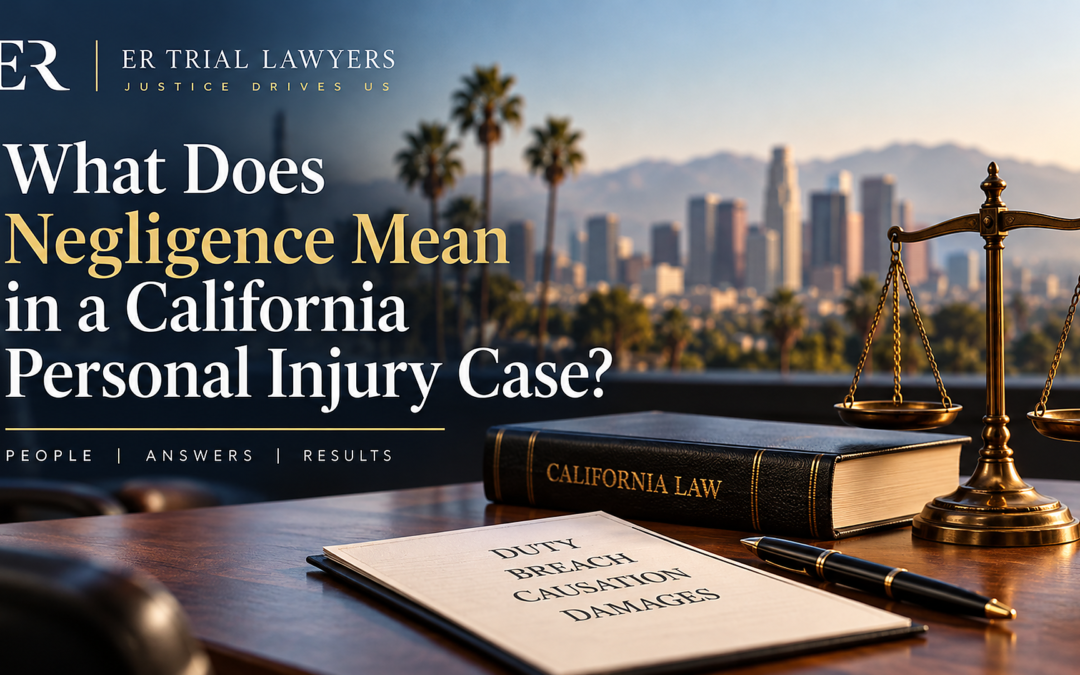
Most California personal injury cases come down to one central question: was someone negligent?
Negligence is the legal concept used to determine whether a person, business, property owner, driver, or other party failed to act with reasonable care and caused someone else to be injured.
That sounds simple, but proving negligence usually requires more than showing that an accident happened. The injured person generally must establish that the other party owed a duty of care, failed to meet that duty, caused the injury, and created actual damages.
Understanding those elements can help explain why some claims are straightforward while others require extensive investigation, expert analysis, or trial preparation.
What Is Negligence Under California Law?
In everyday language, negligence often means carelessness. In a personal injury case, the concept is more specific.
A person may be considered negligent when they fail to use the level of care that a reasonably careful person would use under similar circumstances, and that failure causes injury to someone else.
The standard changes depending on the situation. A driver approaching a busy intersection has different responsibilities than a store owner maintaining a walkway or a manufacturer designing a consumer product. What matters is whether the conduct fell below the level of care the law required under the circumstances.
Negligence can arise in many types of cases, including:
- Car, truck, motorcycle, bicycle, and pedestrian accidents
- Dangerous property conditions
- Unsafe roadways
- Construction accidents
- Defective products
- Wrongful death claims
- Other incidents in which careless conduct causes injury
The Four Elements of a Negligence Claim
To establish negligence, an injured person generally must prove four basic elements: duty, breach, causation, and damages.
1. Duty of Care
The first question is whether the defendant owed the injured person a legal duty to act with reasonable care.
Drivers, for example, have a duty to operate their vehicles with reasonable care. Property owners may have duties relating to dangerous conditions on property they control. Businesses may have obligations to maintain reasonably safe premises for customers.
Whether a duty exists can depend on the relationship between the parties and the circumstances surrounding the incident.
2. Breach of Duty
Once a duty is established, the next question is whether the defendant breached it.
A breach occurs when someone fails to act as a reasonably careful person would have acted under similar circumstances.
Examples might include a driver speeding through a red light, a property owner ignoring a dangerous condition, or a company failing to address a known safety problem.
The important issue is not simply whether the defendant made a mistake. The question is whether the conduct fell below the applicable standard of reasonable care.
3. Causation
Proving that someone acted carelessly is not enough by itself. The injured person must also connect that conduct to the injury.
This is where many cases become complicated.
For example, an insurance company may acknowledge that its insured caused a collision but argue that the crash did not cause all of the medical problems being claimed. In another case, several parties may have contributed to the same accident.
Medical records, accident reconstruction, witness testimony, photographs, video, expert opinions, and other evidence may become important when causation is disputed.
4. Damages
Finally, negligence must result in actual harm.
Depending on the case, damages may include medical expenses, lost income, reduced earning capacity, future treatment costs, physical pain, emotional distress, disability, disfigurement, and loss of enjoyment of life.
A serious injury case may involve both economic damages that can be documented with financial records and non-economic damages that reflect the human impact of the injury.
What Does “Reasonable Care” Mean?
Reasonable care does not require perfection. The law generally asks how a reasonably careful person would have acted under the same or similar circumstances.
That makes negligence highly fact-dependent.
Consider a driver traveling at the posted speed limit. That may ordinarily be reasonable. But the same speed could become unsafe during heavy rain, dense fog, or traffic congestion. The surrounding circumstances matter.
The same principle can apply to businesses and property owners. A hazard that appears suddenly may present a very different liability question than a dangerous condition that existed long enough for the responsible party to discover and correct it.
How Is Negligence Proven?
Negligence is often established by building a detailed picture of what happened before, during, and after an accident.
Important evidence may include:
- Police or incident reports
- Photographs and video
- Surveillance footage
- Witness statements
- Vehicle damage
- Medical records
- Cellphone or electronic records when relevant
- Maintenance and inspection records
- Company policies and safety procedures
- Expert testimony
In serious cases, preserving evidence early can be especially important. Video may be overwritten, vehicles may be repaired, roadway conditions may change, and witnesses’ memories can fade over time.
What If More Than One Person Was Negligent?
California follows a comparative negligence system. This means responsibility for an injury can be divided among multiple parties, including the injured person.
For example, one driver might be primarily responsible for a collision while another driver is found partially responsible. A person’s compensation can be reduced according to their percentage of fault.
This is important because being partly responsible for an accident does not automatically eliminate a California personal injury claim.
Insurance companies may nevertheless try to shift as much fault as possible onto the injured person because a higher percentage of comparative fault can reduce what the insurer ultimately pays.
Negligence Does Not Always Look Obvious
Some cases involve conduct that appears clearly negligent from the beginning. Others require much more investigation.
A roadway accident, for example, may initially appear to be caused entirely by driver error. Further investigation could reveal that defective roadway design, poor signage, inadequate maintenance, or a vehicle defect also contributed to the crash.
Likewise, a fall on commercial property may involve questions about how long a hazard existed, whether employees knew about it, what inspection procedures were in place, and whether reasonable steps were taken to protect visitors.
Identifying every potentially responsible party matters because serious injuries can create losses far beyond the limits of a single insurance policy.
Why Insurance Companies Dispute Negligence
Liability is one of the primary issues insurance companies evaluate when deciding whether to pay a claim and how much to offer.
Even when fault seems clear, an insurer may dispute how the accident occurred, argue that another party was responsible, challenge whether the defendant’s conduct actually caused the injuries, or claim the injured person contributed to the incident.
The insurer may also separate liability from damages. It can accept that its insured was negligent while still challenging the severity of the injuries or the amount of compensation being requested.
That is why a personal injury claim often requires evidence addressing both who was responsible and what the responsible conduct actually caused.
How Negligence Affects the Value of a Personal Injury Case
The strength of the liability evidence can directly affect settlement negotiations.
When negligence and causation are well documented, an insurance company faces greater risk if the case proceeds to trial. When important facts are disputed, the insurer may rely on those uncertainties to reduce its offer.
Case value also depends on the seriousness of the injuries, available insurance coverage, future medical needs, lost earnings, permanent limitations, pain and suffering, and other damages.
For that reason, there is no single formula for determining the value of a negligence claim.
Negligence in Common California Injury Cases
Car Accidents
Negligence in a car accident may involve speeding, distracted driving, unsafe turns, following too closely, failing to yield, impaired driving, or other unsafe conduct.
Premises Liability
Property-related claims may involve inadequate maintenance, dangerous walkways, poor lighting, unsafe stairs, insufficient security, or hazards that were not corrected or adequately warned about.
Dangerous Roadways
Some crashes involve conditions beyond the drivers themselves. Road design, sight-distance problems, missing or confusing signs, dangerous intersections, or maintenance issues may contribute to a serious collision.
Defective Products
Product injury cases can involve legal theories that differ from ordinary negligence, including strict product liability. Depending on the facts, a case may involve design defects, manufacturing defects, or inadequate warnings.
Frequently Asked Questions About Negligence in California
Potentially, yes. California’s comparative fault rules generally allow an injured person to recover damages even when they share responsibility, although the recovery may be reduced according to their percentage of fault.
No. An accident by itself does not automatically establish negligence. The available evidence must support the required elements, including duty, breach, causation, and damages.
An insurer’s fault determination is not necessarily the final word. Evidence such as photographs, video, witness statements, physical damage, expert analysis, and other records may support a different allocation of responsibility.
Deadlines depend on the type of claim and the parties involved. Some California personal injury claims are subject to a two-year limitations period, while claims involving government entities can have much shorter administrative deadlines. Because exceptions can apply, it is important to evaluate the applicable deadline promptly.
California does not require every injured person to hire an attorney. However, cases involving serious injuries, disputed liability, multiple responsible parties, government entities, defective products, or substantial future damages can involve complicated legal and evidentiary issues.
Building a Strong California Personal Injury Claim
Negligence is the foundation of many personal injury cases, but successful claims depend on evidence rather than assumptions.
A careful investigation can help determine what happened, who may be legally responsible, how the conduct caused the injury, and the full extent of the resulting losses.
For people facing serious or permanent injuries, those details can have a major effect on the outcome of a claim.
Ellis Riccobono, LLP represents injured clients in Ventura County, Los Angeles County, and throughout California in serious personal injury matters. The firm’s trial lawyers investigate liability, preserve evidence, evaluate damages, and prepare cases for trial when necessary.