
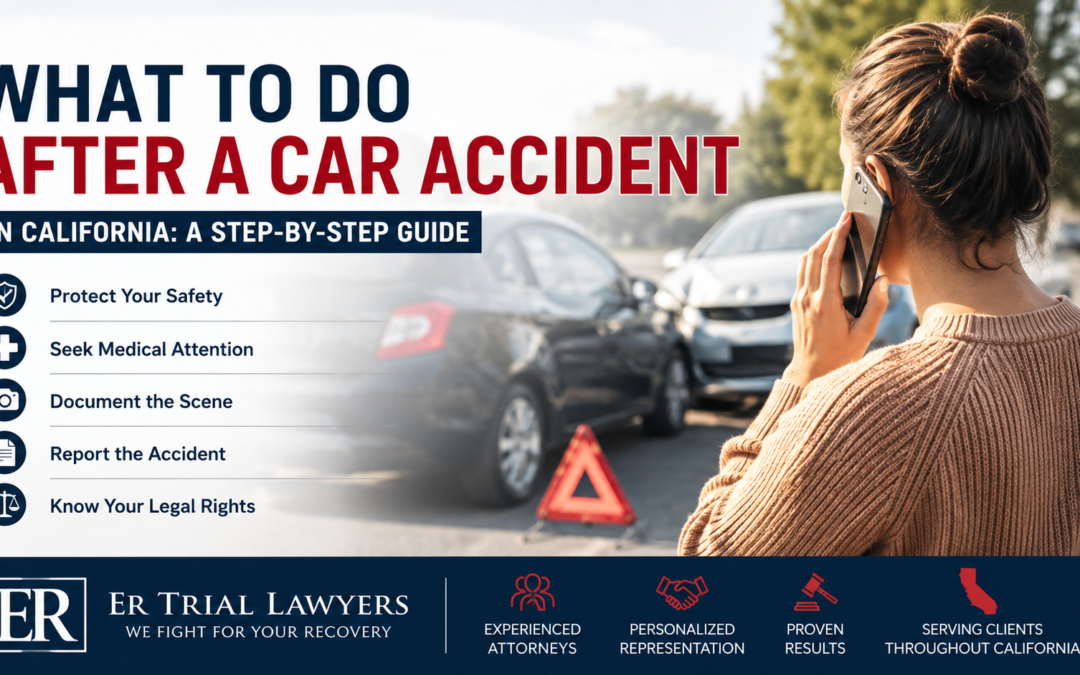
What to Do After a Car Accident in California
A car accident can happen in seconds, but the decisions you make immediately afterward can affect your health, your insurance claim, and your ability to recover compensation. Whether you’ve been involved in a minor collision or a serious crash, knowing what to do after a car accident in California can help protect both your well-being and your legal rights.
In the moments following an accident, it’s natural to feel overwhelmed or unsure of what to do next. You may be dealing with injuries, vehicle damage, emergency responders, and questions from insurance companies—all while trying to process what just happened.
Taking the right steps after an accident can help:
- Protect your health
- Preserve important evidence
- Strengthen your insurance claim
- Document the cause of the accident
- Reduce the risk of costly mistakes
- Protect your legal rights
While every accident is different, there are several important actions that most drivers should take as soon as it is safe to do so.
This guide explains the essential steps to take after a car accident in California, from seeking medical attention and gathering evidence to reporting the crash and understanding when it may be appropriate to speak with a personal injury attorney.
By acting quickly and making informed decisions, you can put yourself in the best position to protect both your recovery and any potential legal claim.
What Should You Do After a Car Accident in California?
After a car accident in California, make sure everyone is safe, call 911 if anyone is injured, seek medical attention, document the accident scene, exchange information with the other driver, report the crash when required, notify your insurance company, and avoid discussing fault before speaking with an attorney. Taking these steps can help protect both your health and your legal rights.
Stay Safe and Call 911
The moments immediately following a car accident can be confusing and stressful. Your first priority should always be the safety of yourself, your passengers, and others involved in the collision. Before thinking about insurance claims or vehicle damage, take a moment to assess the situation and determine whether anyone has been injured.
If the accident creates a dangerous situation, such as blocking traffic or exposing occupants to additional hazards, move to a safe location if it is possible to do so without increasing the risk of injury.
Check for Injuries
Begin by checking yourself and your passengers for injuries.
Even if injuries appear minor, watch for symptoms such as:
- Head pain or dizziness
- Neck or back pain
- Difficulty moving
- Bleeding
- Confusion
- Loss of consciousness
Some injuries, including traumatic brain injuries and internal injuries, may not produce immediate symptoms. If there is any doubt about the severity of an injury, seek emergency medical assistance.
Call 911
If anyone is injured, call 911 immediately.
Emergency responders can:
- Provide medical assistance
- Evaluate injuries
- Secure the accident scene
- Prepare an official police report
- Help direct traffic when necessary
Even when injuries appear minor, having emergency personnel respond can create valuable documentation of the accident and the condition of everyone involved.
Move to a Safe Location When Possible
If the vehicles are creating a traffic hazard and can be moved safely, relocate them to the shoulder or another safe area.
If moving the vehicles is not possible:
- Turn on your hazard lights.
- Remain inside your vehicle if it is safer to do so.
- Stay away from moving traffic whenever possible.
Never place yourself at unnecessary risk simply to inspect vehicle damage or retrieve personal belongings.
Stay Calm and Avoid Confrontation
Car accidents can be emotional experiences, and it is not uncommon for drivers to become upset or argumentative.
Remain calm and avoid:
- Admitting fault
- Arguing with the other driver
- Speculating about what caused the accident
- Making accusations
Fault is often determined after investigators, insurance companies, and, in some cases, accident reconstruction experts review the available evidence.
Cooperate With Law Enforcement
When police arrive, answer questions honestly and provide factual information about what occurred.
Avoid guessing or making statements you’re unsure about.
If you do not know the answer to a question, it is perfectly acceptable to say so.
The responding officer’s report may become an important piece of evidence during the insurance claims process or any future personal injury case.
Safety Comes Before Everything Else
It is natural to worry about vehicle damage after an accident, but protecting human life and preventing further injuries should always come first.
Once everyone is safe and emergency responders have been notified, you can begin documenting the accident and preserving evidence that may later support your insurance claim or legal case.
One of the biggest mistakes accident victims make is declining medical care because they “feel okay.” Many serious injuries—including concussions, spinal injuries, and internal bleeding—may not become apparent until hours or even days after the collision.
Seek Medical Attention Immediately
After a car accident, adrenaline and shock can mask pain and other symptoms, making it difficult to recognize the full extent of your injuries. Even if you feel relatively normal immediately after a crash, it is important to seek prompt medical attention. Some of the most serious injuries—including traumatic brain injuries, spinal injuries, and internal bleeding—may not become apparent until hours or even days later.
Seeking medical care promptly is important not only for your health but also for documenting injuries that may become part of an insurance claim or personal injury lawsuit.
Don’t Assume You’re Uninjured
Many accident victims decline medical treatment because they believe their injuries are minor.
However, symptoms can develop gradually, including:
- Headaches
- Neck pain
- Back pain
- Dizziness
- Numbness or tingling
- Abdominal pain
- Memory problems
- Difficulty concentrating
Ignoring these symptoms or delaying treatment can allow injuries to worsen and make recovery more difficult.
Common Injuries After a Car Accident
Some of the most frequently reported injuries include:
- Whiplash
- Traumatic brain injuries (TBIs)
- Concussions
- Herniated discs
- Spinal cord injuries
- Broken bones
- Soft tissue injuries
- Internal injuries
Even injuries that initially seem minor may require ongoing treatment or rehabilitation.
Follow Your Doctor’s Recommendations
After your initial evaluation, follow your healthcare provider’s treatment plan carefully.
This may include:
- Follow-up appointments
- Physical therapy
- Diagnostic imaging
- Prescription medications
- Specialist referrals
- Occupational or speech therapy
Completing your recommended treatment not only supports your recovery but also helps create a clear medical record documenting the progression of your injuries.
Keep Records of Your Medical Care
Maintaining organized records can be extremely helpful throughout the claims process.
Important documents include:
- Emergency room records
- Physician notes
- Diagnostic test results
- Medical bills
- Prescription receipts
- Physical therapy records
- Mileage for medical appointments
These records help demonstrate the nature and extent of your injuries and may support your claim for compensation.
Delaying Treatment Can Create Challenges
Insurance companies often review the timing of medical treatment when evaluating injury claims.
If there is a significant delay between the accident and your first medical visit, an insurer may argue that:
- Your injuries were not serious.
- The accident did not cause your condition.
- Another event caused your injuries.
Prompt medical evaluation helps establish a clearer connection between the accident and your injuries.
Your Health Should Always Come First
While preserving evidence and dealing with insurance companies are important, your physical recovery should remain the top priority.
Receiving appropriate medical care as soon as possible can improve your chances of recovery while also creating documentation that accurately reflects your injuries and treatment.
Once everyone has received appropriate medical attention, the next priority is preserving evidence from the accident scene. The photographs, witness information, and documentation collected immediately after a collision can play a critical role in determining liability and supporting an insurance claim.
Gather Evidence at the Scene
If it is safe to do so, gathering evidence immediately after a car accident can make a significant difference in your insurance claim or personal injury case. Physical evidence may disappear quickly, vehicles are moved, weather conditions change, and witnesses leave the scene. Taking a few minutes to document what happened can help preserve valuable information before it is lost.
Even if law enforcement responds to the accident, it is still a good idea to collect your own evidence whenever possible.
Take Photographs and Videos
Your smartphone can become one of the most valuable tools after an accident.
Photograph or record:
- All vehicles involved
- Vehicle damage from multiple angles
- License plates
- The overall accident scene
- Skid marks
- Debris on the roadway
- Traffic signals and stop signs
- Road conditions
- Weather conditions
- Visible injuries
If possible, take both close-up photographs and wide-angle images that show the positions of the vehicles and the surrounding area.
Exchange Information With the Other Driver
California law generally requires drivers involved in an accident to exchange identifying information.
Be sure to obtain:
- Full name
- Address
- Phone number
- Driver’s license number
- Insurance company
- Insurance policy number
- Vehicle make and model
- License plate number
Remain polite and professional during the exchange, but avoid discussing fault or arguing about how the accident occurred.
Identify Witnesses
Independent witnesses can provide valuable information if there is a dispute about how the accident happened.
If anyone witnessed the collision, ask for:
- Name
- Phone number
- Email address
If they are willing, you may also ask them to briefly describe what they observed.
Witness testimony often becomes especially important when drivers provide conflicting accounts of the accident.
Document the Accident Scene
In addition to photographs, make notes while the details are still fresh.
Consider documenting:
- The date and time
- The exact location
- Direction each vehicle was traveling
- Traffic conditions
- Weather conditions
- Road hazards
- Statements made by the other driver
Even small details that seem unimportant at the time may later become valuable evidence.
Preserve Digital Evidence
Many modern vehicles and nearby businesses capture valuable electronic evidence.
Potential sources include:
- Dashcam recordings
- Security camera footage
- Traffic camera footage
- Vehicle event data recorders (“black boxes”)
- GPS data
- Smartphone photographs and videos
Because some recordings are automatically deleted after a short period, acting quickly can help preserve important evidence.
Avoid Posting on Social Media
While it may be tempting to share details of the accident online, it is generally best to avoid posting photographs, videos, or comments about the crash.
Insurance companies may review social media accounts and attempt to use posts or photographs to challenge:
- The severity of injuries
- How the accident occurred
- The impact the injuries have had on your daily life
Waiting until your claim has been resolved can help avoid unnecessary complications.
Good Documentation Can Strengthen Your Claim
The evidence collected at the scene often plays an important role in establishing:
- How the accident occurred
- Who was at fault
- The severity of the collision
- The extent of vehicle damage
- The injuries sustained
The more complete your documentation, the better prepared you may be if questions arise during the insurance claims process or litigation.
After documenting the accident, one of the next important steps is ensuring the collision is properly reported. Depending on the circumstances, you may need to notify law enforcement, your insurance company, or the California Department of Motor Vehicles.
Report the Accident
Reporting a car accident is an important step in protecting both your legal rights and your insurance claim. Depending on the circumstances of the collision, you may need to report the accident to law enforcement, your insurance company, and in some cases, the California Department of Motor Vehicles (DMV).
Timely reporting creates documentation that may later help establish how the accident occurred and support your claim for compensation.
Cooperate With Law Enforcement
If police respond to the accident, they will typically investigate the scene and prepare an official traffic collision report.
The responding officer may:
- Interview the drivers and witnesses
- Document vehicle damage
- Record road and weather conditions
- Identify potential traffic violations
- Prepare a written report of the incident
This report can become valuable evidence during the insurance claims process or in a personal injury lawsuit.
When speaking with law enforcement:
- Answer questions honestly.
- Stick to the facts.
- Avoid guessing or speculating.
- Do not admit fault.
If you are unsure about something, it is perfectly acceptable to say you do not know.
Notify Your Insurance Company
Most automobile insurance policies require policyholders to report accidents within a reasonable period of time.
When contacting your insurer:
- Provide accurate factual information.
- Cooperate with the claims process.
- Avoid speculation about fault.
- Keep copies of all communications.
Prompt notification helps your insurance company begin its investigation and determine what coverages may apply.
Understand California DMV Reporting Requirements
California law may require drivers to report certain accidents to the Department of Motor Vehicles.
Generally, a report may be required if the accident results in:
- Injury
- Death
- Property damage that meets the applicable reporting threshold under California law
Because reporting requirements can change, drivers should review the current California DMV requirements following an accident to determine whether additional reporting is necessary.
Keep Copies of Important Documents
Organize and retain copies of all accident-related records, including:
- Police reports
- Insurance claim numbers
- Medical records
- Vehicle repair estimates
- Photographs
- Witness information
- Correspondence with insurance companies
Having these documents readily available can simplify the claims process and help support your case if disputes arise.
Continue Documenting Your Recovery
Reporting the accident is only the beginning of the documentation process.
Continue keeping records of:
- Medical appointments
- New symptoms
- Missed work
- Out-of-pocket expenses
- Communications with insurers
- Changes in your condition
This ongoing documentation helps create a more complete picture of how the accident has affected your life.
Accurate Reporting Helps Protect Your Claim
Providing timely, accurate information to the appropriate parties can help reduce misunderstandings and preserve important evidence.
At the same time, remember that reporting an accident does not require you to speculate about fault or minimize your injuries. If you are uncertain about any aspect of the collision, it is generally best to limit your statements to facts you know to be true.
Once the accident has been reported, you’ll likely begin receiving calls from insurance adjusters. How you handle those conversations can have a significant impact on your claim.
Notify Your Insurance Company
After a car accident, you should notify your insurance company as soon as reasonably possible. Most insurance policies require prompt reporting, and delaying notification could complicate the claims process. However, while it is important to cooperate with your insurer, it is equally important to understand your rights before providing detailed statements or accepting a settlement offer.
The goal is to report the accident accurately while avoiding statements that could later be misunderstood or taken out of context.
Report the Basic Facts
When contacting your insurance company, stick to the facts you know.
Be prepared to provide:
- The date and time of the accident
- The location of the collision
- The names of the drivers involved
- Vehicle information
- The responding law enforcement agency, if applicable
- Your claim or incident number, if available
Avoid speculating about who caused the accident or discussing injuries that have not yet been evaluated by a medical professional.
Be Cautious With Recorded Statements
Insurance adjusters may ask you to provide a recorded statement shortly after the accident.
While your own insurance company may request information to process your claim, you should understand:
- You are not required to guess or speculate.
- You should answer only questions you know to be true.
- It is acceptable to say you do not know or do not remember.
- You should not minimize your injuries simply because symptoms seem mild.
If the other driver’s insurance company requests a recorded statement, consider seeking legal advice before participating. Statements made early in the claims process may later be used to dispute liability or the extent of your injuries.
Don’t Rush to Accept a Settlement
Insurance companies sometimes make early settlement offers before the full extent of an injury is known.
Accepting an offer too quickly may prevent you from recovering compensation for:
- Future medical treatment
- Ongoing rehabilitation
- Lost earning capacity
- Long-term pain and suffering
Once a settlement agreement is finalized, you generally cannot return later and request additional compensation if your condition worsens.
Keep a Record of Every Conversation
Create a file for all communications related to your accident.
Keep track of:
- Dates and times of phone calls
- Names of insurance representatives
- Emails and letters
- Claim numbers
- Settlement offers
- Notes from conversations
Maintaining detailed records can help resolve misunderstandings and provide valuable documentation if disputes arise.
Understand Your Insurance Coverage
Many drivers are unfamiliar with the protections included in their own insurance policies.
Depending on your coverage, benefits may include:
- Uninsured Motorist (UM) coverage
- Underinsured Motorist (UIM) coverage
- Medical Payments (MedPay) coverage
- Collision coverage
- Rental vehicle reimbursement
Understanding your available coverage can help you make informed decisions throughout the claims process.
Continue Following Your Medical Treatment
Insurance companies often review medical records when evaluating claims.
Continue to:
- Attend scheduled appointments.
- Follow your physician’s recommendations.
- Complete prescribed therapy.
- Report new or worsening symptoms.
Consistent medical treatment helps support both your recovery and the documentation of your injuries.
Protect Your Claim From the Beginning
The way you communicate with insurance companies in the days following an accident can influence the outcome of your claim.
Providing accurate information, maintaining organized records, and avoiding premature settlement decisions can help protect your rights while your injuries and damages are being fully evaluated.
Even when people have the best intentions, small mistakes after a car accident can significantly affect their ability to recover compensation. Fortunately, many of these errors are entirely avoidable.
Avoid Common Mistakes After an Accident
The decisions you make after a car accident can have a lasting impact on both your physical recovery and your ability to recover compensation. Even small mistakes made in the hours or days following a crash may create challenges during the insurance claims process or a personal injury lawsuit.
Fortunately, many of the most common mistakes are avoidable.
Delaying Medical Treatment
One of the biggest mistakes accident victims make is waiting too long to seek medical care.
Some injuries—particularly:
- Traumatic brain injuries
- Concussions
- Whiplash
- Internal injuries
- Soft tissue injuries
may not produce immediate symptoms.
Delaying treatment can not only affect your recovery but may also allow insurance companies to argue that your injuries were unrelated to the accident or were not serious.
Admitting Fault
Many people apologize after an accident simply out of politeness.
However, statements such as:
- “I’m sorry.”
- “I didn’t see you.”
- “The accident was my fault.”
may later be interpreted as admissions of liability.
Fault should be determined after all available evidence has been reviewed—not in the stressful moments immediately following a collision.
Failing to Gather Evidence
Important evidence often disappears quickly after an accident.
Whenever it is safe to do so, collect:
- Photographs
- Videos
- Witness contact information
- Vehicle damage
- Road conditions
- Traffic signs and signals
Strong evidence can help establish how the accident occurred and support your claim if liability is later disputed.
Ignoring Your Doctor’s Advice
Once medical treatment begins, it is important to follow your healthcare provider’s recommendations.
Missing appointments or stopping treatment prematurely may:
- Delay recovery.
- Create gaps in your medical records.
- Give insurers an opportunity to question the seriousness of your injuries.
Following your treatment plan helps document the progression of your recovery.
Posting About the Accident on Social Media
Insurance companies sometimes review public social media accounts during an investigation.
Photographs, videos, or comments posted online may be used to argue that:
- Your injuries are less severe than claimed.
- You have recovered more quickly than reported.
- Your daily activities are inconsistent with your medical condition.
Even seemingly harmless posts can be taken out of context.
Accepting the First Settlement Offer
An early settlement offer may seem appealing, especially if medical bills and lost wages are creating financial pressure.
However, accepting compensation before you understand the full extent of your injuries may leave you responsible for:
- Future medical expenses
- Ongoing rehabilitation
- Lost earning capacity
- Long-term pain and suffering
Once a settlement is finalized, additional compensation is generally unavailable.
Waiting Too Long to Learn Your Legal Rights
Many people believe they have unlimited time to decide whether to pursue a claim.
In reality, California law establishes filing deadlines that may affect your ability to recover compensation.
Waiting too long can also make it more difficult to:
- Preserve evidence
- Locate witnesses
- Obtain surveillance footage
- Build a strong case
Learning about your legal options early does not mean you must file a lawsuit—it simply helps ensure important deadlines and evidence are not overlooked.
Protect Yourself From Avoidable Mistakes
Most accident victims have never been through the claims process before. Taking a thoughtful, informed approach after an accident can help protect both your health and your legal rights.
Seeking prompt medical care, preserving evidence, documenting your recovery, and understanding your insurance coverage can all contribute to a stronger claim and a smoother recovery process.
After taking these important steps, many people begin wondering whether they should speak with a lawyer. While not every accident requires legal representation, certain situations may benefit from experienced legal guidance.
When Should You Contact a Personal Injury Lawyer?
Not every car accident requires legal representation. However, when injuries are serious, liability is disputed, or the insurance company refuses to offer fair compensation, having an experienced personal injury lawyer can make a significant difference.
Many people wait until problems arise before seeking legal advice. In reality, speaking with an attorney early in the process can help protect important evidence, preserve your legal rights, and avoid mistakes that could negatively affect your claim.
Serious Injuries Often Require Legal Guidance
You should consider speaking with a personal injury lawyer if the accident resulted in serious injuries, including:
- Traumatic brain injuries
- Spinal cord injuries
- Broken bones
- Internal injuries
- Permanent disability
- Significant scarring or disfigurement
These cases often involve substantial medical expenses, future treatment needs, and long-term financial losses that should be carefully evaluated.
Liability Is Being Disputed
Some accidents involve conflicting accounts of what happened.
If:
- The other driver denies responsibility.
- Multiple vehicles were involved.
- There are conflicting witness statements.
- The insurance company disputes fault.
an attorney can help investigate the accident, preserve evidence, and work to establish liability.
The Insurance Company Is Undervaluing Your Claim
Insurance companies may attempt to minimize the value of a claim by:
- Questioning the severity of your injuries
- Challenging medical treatment
- Disputing lost wages
- Offering a quick settlement before your recovery is complete
Understanding the full value of your damages before accepting a settlement can help prevent costly mistakes.
A Government Entity May Be Responsible
If your accident involved:
- A dangerous roadway
- A defective intersection
- Poor road maintenance
- A government-owned vehicle
special claim procedures and shorter filing deadlines may apply.
These cases often require prompt investigation because evidence may disappear and government claim deadlines can arrive much sooner than the standard statute of limitations.
An Uninsured or Underinsured Driver Is Involved
Recovering compensation can become more complicated when the at-fault driver has:
- No insurance
- Insufficient insurance coverage
- Left the scene of the accident
An attorney can help identify all available insurance coverage, including uninsured and underinsured motorist benefits that may be available through your own policy.
You Have Questions About Your Rights
Even if you’re unsure whether you have a legal claim, an initial consultation can help answer important questions, such as:
- Who may be responsible?
- What compensation may be available?
- How long do you have to file a claim?
- What evidence should be preserved?
- What should you expect during the insurance process?
Understanding your options early allows you to make informed decisions about your case.
Early Legal Guidance Can Make a Difference
Consulting an attorney soon after an accident can help:
- Preserve evidence before it disappears.
- Identify all potentially responsible parties.
- Ensure important deadlines are met.
- Communicate with insurance companies.
- Evaluate the full value of your claim.
- Protect your legal rights throughout the claims process.
Taking action early often places accident victims in a stronger position as their case moves forward.
We’re Here to Help
At ER Trial Lawyers, we understand that the days following a serious car accident can be overwhelming. Our team helps injury victims throughout California investigate accidents, navigate the insurance process, and pursue compensation for medical expenses, lost income, pain and suffering, and other damages.
We offer free consultations, and there are no upfront legal fees. If you’ve been injured in a California car accident and have questions about your legal rights, we’re here to help you understand your options.
Contact ER Trial Lawyers today to schedule a free case evaluation.
Your first priority should be safety. Check yourself and others for injuries, call 911 if anyone is hurt, move to a safe location if possible, exchange information with the other driver, document the accident scene, and seek medical attention as soon as possible.
If the accident involves injuries, death, or significant property damage, you should contact law enforcement. A police report can provide important documentation that may help support an insurance claim or personal injury case.
Yes. Many injuries—including traumatic brain injuries, whiplash, and internal injuries—may not produce symptoms immediately. Prompt medical evaluation helps protect your health and creates documentation connecting your injuries to the accident.
You should obtain the other driver’s:
- Name
- Address
- Phone number
- Driver’s license number
- Insurance company
- Insurance policy number
- Vehicle registration information
- License plate number
Avoid discussing fault or arguing about how the accident occurred.
If it is safe to do so, gather:
- Photographs of the accident scene
- Vehicle damage
- Visible injuries
- Road conditions
- Traffic signs and signals
- Witness contact information
- Videos of the scene when possible
This evidence may become important if liability is disputed.
You should report the accident to your own insurance company, but you should be cautious about providing recorded statements—especially to the other driver’s insurer. If you have questions about your rights, speaking with an attorney before giving a recorded statement may be beneficial.
Common mistakes include:
- Delaying medical treatment
- Admitting fault
- Failing to gather evidence
- Posting about the accident on social media
- Ignoring your doctor’s recommendations
- Accepting an early settlement offer before understanding the full extent of your injuries
Avoiding these mistakes can help protect your claim.
You should consider contacting a lawyer if you suffered serious injuries, liability is disputed, the insurance company is denying or undervaluing your claim, a government entity may be responsible, or the at-fault driver is uninsured or underinsured.
In many cases, California law allows two years from the date of the injury to file a personal injury lawsuit. However, claims involving government entities and certain other situations may have different deadlines, making it important to act promptly.
Yes. California follows a pure comparative negligence system, which means you may still recover compensation even if you were partially responsible for the accident. However, your recovery may be reduced by your percentage of fault.